
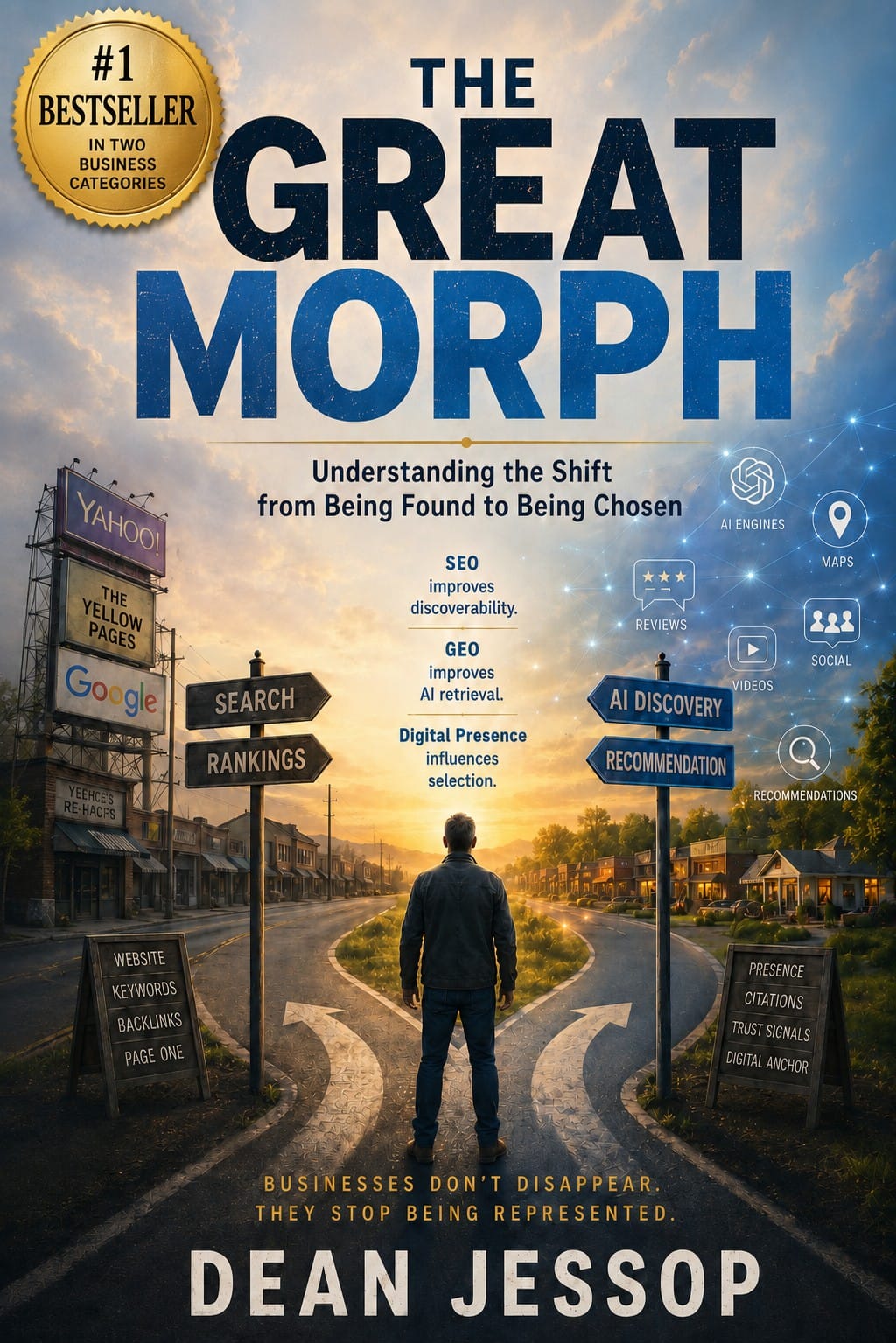
The Great Morph, by Dean Jessop, explains a gradual change in how customers discover and evaluate businesses.
People still use websites, Google Search, maps, reviews and referrals. Those channels have not disappeared. What is changing is the path customers take through them. People increasingly ask complete questions and encounter summaries, maps, reviews, recommendations and AI-assisted answers before visiting a business’s website.
The book calls this change The Great Morph: the movement from a web focused mainly on whether a business can be found toward a broader discovery environment that also asks whether the business is clear, credible and represented well enough to be considered.
Search is expanding, not disappearing
The Great Morph does not claim that SEO is dead or that AI has replaced Google. It argues that traditional search has become one part of a larger discovery process.
A customer might encounter a business through a search result, map listing, review, video, social post, directory, referral or AI-generated summary. These different sources can influence the decision before the customer contacts the business.
This makes the consistency and usefulness of a business’s public information more important. A website remains valuable, but it is no longer the only place where the business must be represented clearly.
The three layers of modern visibility
The book organizes modern business visibility into three connected layers:
- SEO is the discoverability layer. It helps search systems find, crawl, understand and evaluate business information.
- GEO is the recommendation layer. It focuses on making information clear and useful enough to be retrieved, referenced, summarized or cited within generative and AI-assisted systems.
- Trust is the conversion layer. Reviews, photographs, reputation, credentials, local relevance and visible proof help a real customer decide whether to act.
A business can be discoverable without being selected.
It can appear in search results without giving customers enough confidence to call, visit or buy. Effective visibility therefore requires more than simply appearing online.
The Digital Ghost
A Digital Ghost is a real business that may be respected and successful offline but is weakly or inconsistently represented online.
The business may have years of experience, loyal customers and an excellent reputation. However, its website may be vague, its photographs outdated, its reviews old, its service area unclear or its contact information inconsistent across different platforms.
This does not make it a poor business. It makes the business harder for new customers and digital systems to understand.
The solution is not to manufacture authority. It is to translate the business’s genuine experience, services, reputation and community connections into visible public evidence.
The Digital Handshake
The Digital Handshake is the alignment between what a business says about itself and what the surrounding digital environment confirms.
A website may claim that a business provides a particular service in a particular area. Reviews, maps, professional profiles, community references, photographs and other credible sources can either support or contradict that claim.
When these sources consistently describe the same business, services, location and experience, they reduce uncertainty. This helps customers evaluate the business and gives search and AI-assisted systems clearer information to interpret.
The Digital Handshake is not one link, review or profile. It is the broader pattern created when multiple legitimate sources point toward the same understanding.
The Digital Anchor
A Digital Anchor is the stable representation of a business across the different places where customers and digital systems look for information.
A strong Digital Anchor clearly answers six questions:
- Who is the business?
- What does it provide?
- Where does it operate?
- What problems does it solve?
- What evidence supports its claims?
- Where else is its information confirmed?
The purpose is not to control search platforms. It is to keep the business understandable as platforms, interfaces and customer behaviour continue to change.
What realistically improves visibility
The book identifies seven practical areas that businesses can improve:
- Clarity. Explain what the business does, who it serves, where it operates and which problems it solves.
- Consistency. Keep names, contact information, hours, locations, service areas and descriptions aligned across important platforms.
- Proof. Support claims with genuine reviews, photographs, testimonials, credentials, examples and community references.
- Usefulness. Answer the real questions customers ask before making a decision.
- Context. Make geographic, industry or audience relevance clear.
- Corroboration. Build legitimate references through customers, partners, associations, media, directories and community relationships.
- Maintenance. Review and update public information as the business and its services change.
These actions cannot guarantee rankings, citations, recommendations, traffic, leads or customers. They can make the business easier for people and systems to identify, understand and evaluate.
What being chosen actually means
The book uses the phrase agreed-upon answer, but it does not mean that one platform officially declares a business the winner.
It describes a position where the website, profiles, reviews, maps, content and public references consistently support the same basic conclusion: the business is real, relevant, active and worth considering.
Search engines and AI systems control their own crawling, indexing, rankings, citations and recommendations. Customers still make the final decision.
The central message
The Great Morph is not about abandoning SEO or chasing every new AI platform. It is about building a clearer and more durable representation of the real business.
Good businesses can be overlooked when their public information is scattered, outdated or vague. The practical response is to make their genuine services, experience, reputation and local relevance easier to find and verify.
The goal is not louder marketing. It is better representation.
Read The Great Morph
Dean Jessop wrote The Great Morph for business owners, entrepreneurs and professionals who want a plain-language explanation of how search and AI-assisted discovery are changing.
View The Great Morph on Amazon Canada